As-salāmu ʿalaykum wa raḥmatullāhi wa barakātuh, dear brothers and sisters,
We conducted a survey among medical professionals and asked them which topics they would like to see addressed from an Islamic-legal perspective, so they can better navigate such questions in their daily practice.
Survey Results
Top 3 topics in the medical field
- Obligation to treat (DNR/DNI)
- Organ donation
- Cross-gender treatment in Islam
Survey Results
Most frequently named in the psychological field
- Psychotropic medication from an Islamic perspective
- Addictive disorders and addiction therapy
- Legal responsibility (Taklīf)
The results make clear how relevant the intersection of Islam, medicine, and society has become. It is precisely at this intersection that HAKIM seeks to act — because the named topics affect not only individual patients or practitioners, but also touch upon medical practice, Islamic-legal evaluation, and collective societal responsibility.
Our aim is to address these questions not sporadically but systematically, within a multiprofessional team of medical specialists and Islamic scholars — as Allah already enabled us to do with the Ramadan Compendium.
In summary, our article shows: medical treatment is not categorically obligatory in Islam. This is indicated, among other things, by the hadith of the seventy thousand who will enter Paradise without reckoning:
يَدْخُلُ الْجَنَّةَ مِنْ أُمَّتِي سَبْعُونَ أَلْفًا بِغَيْرِ حِسَابٍ قَالُوا وَمَنْ هُمْ يَا رَسُولَ اللَّهِ قَالَ هُمُ الَّذِينَ لَا يَكْتَوُونَ وَلَا يَسْتَرْقُونَ وَعَلَى رَبِّهِمْ يَتَوَكَّلُونَ
The Prophet ﷺ said: "Seventy thousand from my Ummah will enter Paradise without reckoning." The Companions asked: "Who are they, O Messenger of Allah?" He answered: "They are those who do not seek ruqya, do not believe in bad omens, do not seek cauterization, and place their trust in their Lord."
Sahih Muslim 218
Likewise, the hadith of the woman with epileptic seizures, in which the Prophet ﷺ gave her the choice between patience and a supplication for healing:
إِنِّي أُصْرَعُ وَإِنِّي أَتَكَشَّفُ فَادْعُ اللَّهَ لِي قَالَ إِنْ شِئْتِ صَبَرْتِ وَلَكِ الْجَنَّةُ وَإِنْ شِئْتِ دَعَوْتُ اللَّهَ أَنْ يُعَافِيَكِ
Ibn ʿAbbas reported: A woman came to the Prophet ﷺ and said: "I suffer from epileptic seizures and become uncovered. Please supplicate to Allah for me." He said: "If you wish, be patient and Paradise shall be yours. Or if you wish, I will supplicate to Allah to heal you." She replied: "I will be patient." Then she added: "But I become uncovered — please ask Allah that this not happen." So he supplicated for her.
Sahih al-Bukhari 5652
Scholars derive from this that treatment cannot be obligatory in every case.
At the same time, other narrations show that healing and medical treatment hold a clear and recognized place in Islam. Treatment is therefore fundamentally permissible and often even desirable.
What matters is the distinction:
Patient
Not categorically obligatory
From the patient’s perspective, treatment is not categorically obligatory. Patience and trust in Allah can be an equally valid path.
Physician
Obligatory in life-threatening situations
In an acutely life-threatening situation, treatment can become obligatory for the physician — such as clearing an airway obstruction, removing a poison, or administering fluids for severe dehydration.
Visual Summary
Decision Algorithm
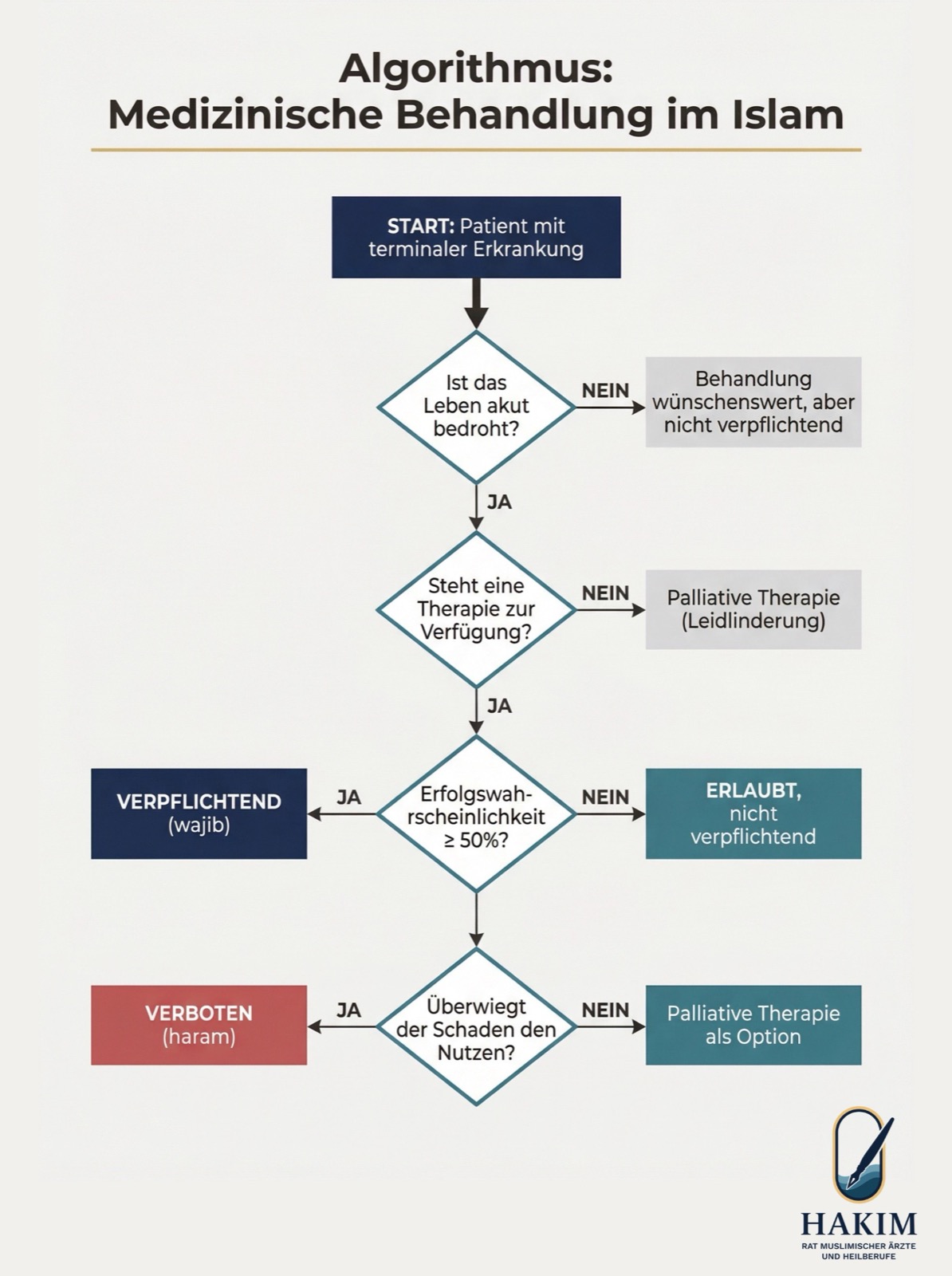
The question of the obligation to treat thus has multiple layers: the patient’s will, the physician’s duty to act, and the evaluation of specific borderline cases. Further questions — such as DNR/DNI, treatment against the patient’s will, or the role of relatives — we address more extensively in the full article and in further forthcoming papers in shāʾ Allāh.