Skip to Content
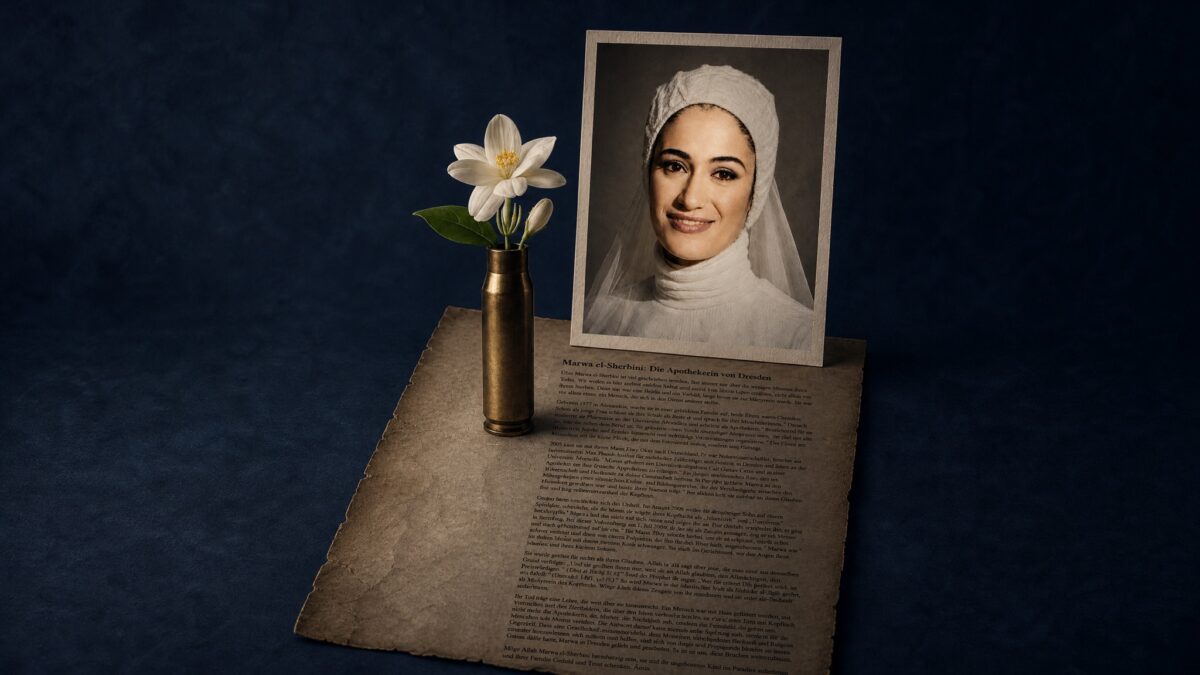
Marwa el-Sherbini
Shahīdat al-Ḥijāb

Marwa el-Sherbini

1977-2009 · Alexandria · Dresden · Pharmacy

The pharmacist of Dresden who died for her Iman.

Much has been written about Marwa el-Sherbini, almost always only about the few minutes of her death. Here we want to do it differently on purpose and speak first of her life, not of her dying alone. For she was a hero and a role model long before she became a martyr: a self-confident Muslim woman who placed herself in the service of others.

Born in Alexandria, she grew up in an educated home; both her parents were chemists. Even at school she stood out, graduated at the top of her class, and spoke on behalf of her fellow students, a natural leader. Her family and neighbours described her as devout and loved by everyone.

She studied pharmacy at the University of Alexandria and became a pharmacist, a profession wholly devoted to the service of people. In 2005 she came to Germany with her husband Elwy Okaz. He was a natural scientist who researched cell genetics, most recently at the renowned Max Planck Institute of Molecular Cell Biology and Genetics in Dresden. Marwa worked as a pharmacist while pursuing her German licensing. A young Muslim couple contributing to this society through science and the healing arts. In Dresden she was involved in building an Islamic cultural and educational centre that today bears her name. She wore her headscarf as a matter of course and with confidence. Her brother does recount the hostilities she experienced in Dresden, and yet, as he remembers it, the family led a good life in Germany.

It was precisely this that ignited the tragedy. In August 2008, her three-year-old son wanted to use the swings at a playground when a man insulted her because of her headscarf, calling her an „Islamist“ and a „terrorist“. Marwa did not let it pass and pressed charges. The court convicted him; he appealed. At that hearing on 1 July 2009, where she testified as a witness, he drew a knife and stabbed her eighteen times. Her husband Elwy rushed to protect her, was himself severely injured, and in the chaos was shot by a police officer who mistook him for the attacker. Marwa was three months pregnant with her second child. She died in the courtroom, before the eyes of her husband and her little son.

A German court later established the motive: sheer hatred of Muslim women and men. It was the first murder in Germany officially recognised as anti-Muslim, and the perpetrator was sentenced to life imprisonment. Marwa, however, was killed for nothing but her faith. Allah taʿālā says of those who were once persecuted for the very same reason:

وَمَا نَقَمُوا۟ مِنْهُمْ إِلَّآ أَن يُؤْمِنُوا۟ بِٱللَّهِ ٱلْعَزِيزِ ٱلْحَمِيدِ

„And they resented them for nothing but that they believed in Allah, the Almighty, the Praiseworthy.“

Sūrat al-Burūj (85:8)

And the Prophet ﷺ said:

مَنْ قُتِلَ دُونَ دِينِهِ فَهُوَ شَهِيدٌ

„Whoever is killed in defence of his Dīn is a Shahīd.“

Jāmiʿ at-Tirmidhī 1421

So Marwa is honoured throughout the Muslim world as Shahīdat al-Ḥijāb, the martyr of the headscarf, while the public response in Germany was long in coming. May Allah accept this testimony from her and admit her among the Shuhadāʾ.

Her death carries a lesson that reaches far beyond her. A human being had been fed with hatred, with prejudice and the distorted images spread about Islam, until in a woman with a headscarf he no longer saw the pharmacist, the mother, the neighbour, but an enemy. Among German pharmacists she was afterwards mourned as a colleague who had been lost. And her brother reported that Marwa had forgiven the perpetrator even in the courtroom, for Islam is also a religion of forgiveness and mercy.

What this teaches us

Bridges, not division

This is how we lose people like Marwa. Enemy images, especially about Islam, are not harmless; they can end in death. The answer to this can never be more division, but only its opposite: that the wise come together and refuse to be driven apart by prejudice and propaganda. This is how Marwa had lived, confident in her faith and in her service to people. It is upon us to do as she did.

May Allah be merciful to Marwa el-Sherbini, admit her and her unborn child into Paradise, and grant her family patience and comfort. Āmīn.

References

  1. Family interview with Marwa’s mother, her brother Tarek, and a childhood friend about her character (devout, beloved by family and neighbours, a leader). Al-Yaum as-Sābiʿ (Youm7), 9 July 2009. Youm7
  2. Studied pharmacy at the University of Alexandria (bachelor’s degree 2000), profession pharmacist. Al Jazeera, encyclopedia entry „Marwa el-Sherbini“ (2014). Al Jazeera
  3. Husband Elwy Ali Okaz, natural scientist in the field of cell genetics, with a research position at the Max Planck Institute of Molecular Cell Biology and Genetics in Dresden; move to Germany in 2005. Al Jazeera, encyclopedia entry (2014); Saxon State Ministry of Justice, Medienservice Sachsen. Al Jazeera, Medienservice Sachsen
  4. Involvement in an Islamic cultural and educational centre in Dresden that today bears her name. Der Tagesspiegel, „Dresden: Freunde planen Marwas Ort“. Der Tagesspiegel
  5. Interview with her brother Tarek El-Sherbini (hostilities over the headscarf, „a good life in Germany“, Marwa’s forgiveness of the perpetrator in the courtroom). IslamiQ, „Meine Schwester Marwa hatte dem Angeklagten vergeben“, 1 July 2020. IslamiQ
  6. Incident in August 2008 at a Dresden playground, insulted as an „Islamist“ and „terrorist“. Saxon State Ministry of Justice, Medienservice Sachsen. Medienservice Sachsen
  7. Murder on 1 July 2009 at the Dresden Regional Court with eighteen knife wounds. Liz Fekete, „Germany: why did Marwa al-Sherbini die?“, Institute of Race Relations, 8 July 2009; taz, „Prozess hinter Panzerglas“, 22 October 2009. Institute of Race Relations, taz
  8. Her husband Elwy Okaz was severely injured while trying to protect her and was shot by a police officer who mistook him for the attacker. Der Tagesspiegel (dpa), „El-Sherbini-Prozess: Täter wollte erschossen werden“, 3 November 2009. Der Tagesspiegel
  9. Motive „hatred of Muslim women and men“, official classification as a racially motivated murder, life imprisonment (judgment of the Dresden Regional Court of 11 November 2009). Medienservice Sachsen; taz, 22 October 2009. Medienservice Sachsen, taz
  10. Qur’an, Sūra al-Burūj (85:8): وَمَا نَقَمُوا مِنْهُمْ إِلَّا أَن يُؤْمِنُوا بِاللَّهِ الْعَزِيزِ الْحَمِيدِ. quran.com
  11. „Whoever is killed in defence of his Dīn is a Shahīd.“ Jāmiʿ at-Tirmidhī 1421, from Saʿīd ibn Zayd; at-Tirmidhī graded the Ḥadīth as ḥasan, ṣaḥīḥ according to Darussalam. sunnah.com
  12. On the international recognition as „martyr of the headscarf“ alongside the long absence of a public reaction in Germany: Beverly M. Weber, „Hijab Martyrdom, Headscarf Debates“, Comparative Studies of South Asia, Africa and the Middle East 32(1), 2012, pp. 102-115. doi.org
  13. „With the death of Marwa El-Sherbini we have lost such a colleague.“ Antonie Marqwardt (Deutscher Pharmazeutinnen Verband), „Zum Tod der Apothekerin Marwa El-Sherbini“, Deutsche Apotheker-Zeitung 32/2009, p. 36. Deutsche Apotheker-Zeitung

Further scholarly literature

  1. Beverly M. Weber, „Contentious Headscarves: Cleaning Woman, Forbidden Schoolteacher, Hijab Martyr“, in: Violence and Gender in the „New“ Europe: Islam in German Culture, Palgrave Macmillan 2013, pp. 77-112. doi.org
  2. Iman Attia and Yasemin Shooman, „›Aus blankem Hass auf Muslime‹. Zur Rezeption des Mordes an Marwa el-Sherbini in deutschen Printmedien und im deutschsprachigen Internet“, in: Jahrbuch für Islamophobieforschung 2010, StudienVerlag 2010, pp. 23-46.
  3. Aleksandra Lewicki and Yasemin Shooman, „Building a new nation: anti-Muslim racism in post-unification Germany“, Journal of Contemporary European Studies 28(1), 2020, pp. 30-43. doi.org
  4. Farid Hafez, „Remembering the Murder of Marwa El-Sherbini“, Bridge Initiative, Georgetown University, 5 July 2019. Bridge Initiative

Film, theatre, and remembrance

  1. Es brennt (2023), feature film by Erol Afşin, based on the case (premiere Filmfest München 2023). gorki.de
  2. Recht(s), Über das Verbrechen an Marwa El-Sherbini (2020), theatre project by Ayşe Güvendiren, Münchner Kammerspiele. Münchner Kammerspiele
  3. Al Jazeera English, video report on the perpetrator’s conviction, 11 November 2009. Al Jazeera English
  4. „Day against anti-Muslim racism“ (1 July, since 2015 in memory of Marwa el-Sherbini). CPPD Network
  5. „Marwa-El-Sherbini-Park“ at the Dresden Regional Court, inaugurated in March 2022; permanent memorial stele (2026). IslamiQ, evangelisch.de
  6. Art installation „18 Stiche“ (2010), eighteen knife-shaped steles commemorating the eighteen knife wounds. addn.me
Share:
← Back to Forgotten Heroes