
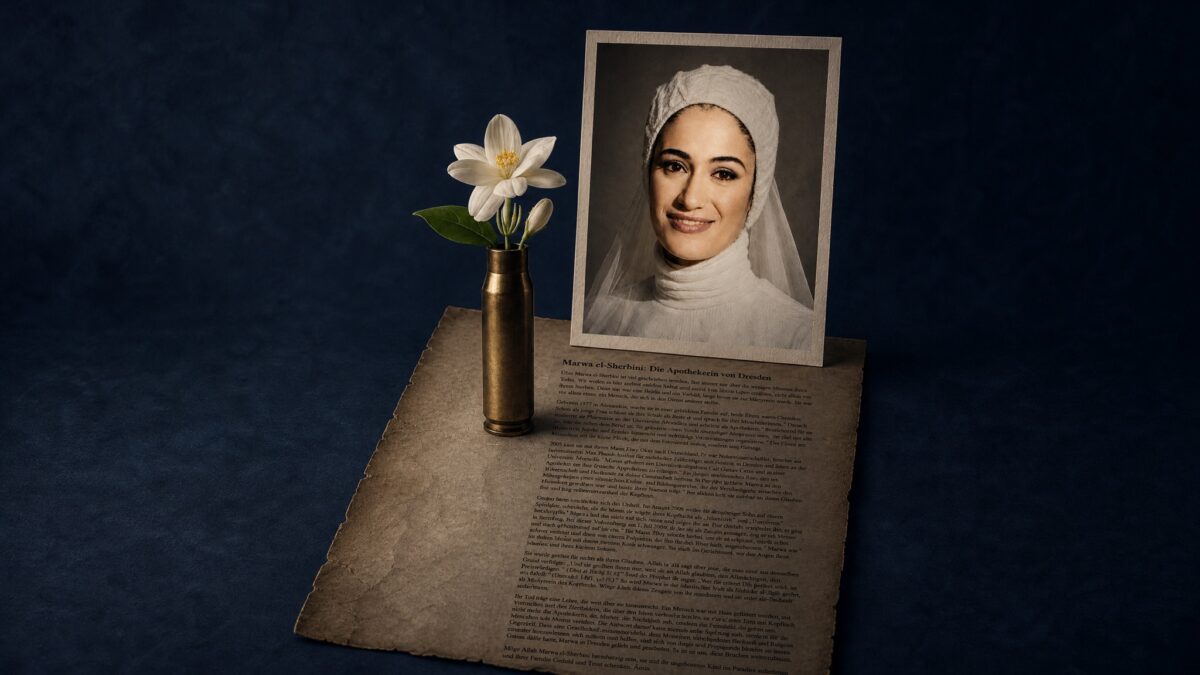
Much has been written about Marwa el-Sherbini, almost always only about the few minutes of her death. Here we want to do it differently on purpose and speak first of her life, not of her dying alone. For she was a hero and a role model long before she became a martyr: a self-confident Muslim woman who placed herself in the service of others.
Born in Alexandria, she grew up in an educated home; both her parents were chemists. Even at school she stood out, graduated at the top of her class, and spoke on behalf of her fellow students, a natural leader. Her family and neighbours described her as devout and loved by everyone.
She studied pharmacy at the University of Alexandria and became a pharmacist, a profession wholly devoted to the service of people. In 2005 she came to Germany with her husband Elwy Okaz. He was a natural scientist who researched cell genetics, most recently at the renowned Max Planck Institute of Molecular Cell Biology and Genetics in Dresden. Marwa worked as a pharmacist while pursuing her German licensing. A young Muslim couple contributing to this society through science and the healing arts. In Dresden she was involved in building an Islamic cultural and educational centre that today bears her name. She wore her headscarf as a matter of course and with confidence. Her brother does recount the hostilities she experienced in Dresden, and yet, as he remembers it, the family led a good life in Germany.
It was precisely this that ignited the tragedy. In August 2008, her three-year-old son wanted to use the swings at a playground when a man insulted her because of her headscarf, calling her an „Islamist“ and a „terrorist“. Marwa did not let it pass and pressed charges. The court convicted him; he appealed. At that hearing on 1 July 2009, where she testified as a witness, he drew a knife and stabbed her eighteen times. Her husband Elwy rushed to protect her, was himself severely injured, and in the chaos was shot by a police officer who mistook him for the attacker. Marwa was three months pregnant with her second child. She died in the courtroom, before the eyes of her husband and her little son.
A German court later established the motive: sheer hatred of Muslim women and men. It was the first murder in Germany officially recognised as anti-Muslim, and the perpetrator was sentenced to life imprisonment. Marwa, however, was killed for nothing but her faith. Allah taʿālā says of those who were once persecuted for the very same reason:
وَمَا نَقَمُوا۟ مِنْهُمْ إِلَّآ أَن يُؤْمِنُوا۟ بِٱللَّهِ ٱلْعَزِيزِ ٱلْحَمِيدِ
„And they resented them for nothing but that they believed in Allah, the Almighty, the Praiseworthy.“
Sūrat al-Burūj (85:8)
And the Prophet ﷺ said:
مَنْ قُتِلَ دُونَ دِينِهِ فَهُوَ شَهِيدٌ
„Whoever is killed in defence of his Dīn is a Shahīd.“
Jāmiʿ at-Tirmidhī 1421
So Marwa is honoured throughout the Muslim world as Shahīdat al-Ḥijāb, the martyr of the headscarf, while the public response in Germany was long in coming. May Allah accept this testimony from her and admit her among the Shuhadāʾ.
Her death carries a lesson that reaches far beyond her. A human being had been fed with hatred, with prejudice and the distorted images spread about Islam, until in a woman with a headscarf he no longer saw the pharmacist, the mother, the neighbour, but an enemy. Among German pharmacists she was afterwards mourned as a colleague who had been lost. And her brother reported that Marwa had forgiven the perpetrator even in the courtroom, for Islam is also a religion of forgiveness and mercy.
Bridges, not division
This is how we lose people like Marwa. Enemy images, especially about Islam, are not harmless; they can end in death. The answer to this can never be more division, but only its opposite: that the wise come together and refuse to be driven apart by prejudice and propaganda. This is how Marwa had lived, confident in her faith and in her service to people. It is upon us to do as she did.
May Allah be merciful to Marwa el-Sherbini, admit her and her unborn child into Paradise, and grant her family patience and comfort. Āmīn.