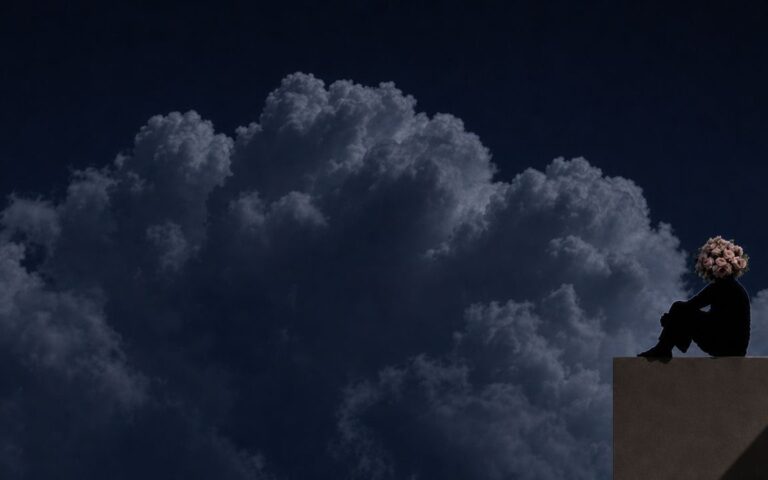
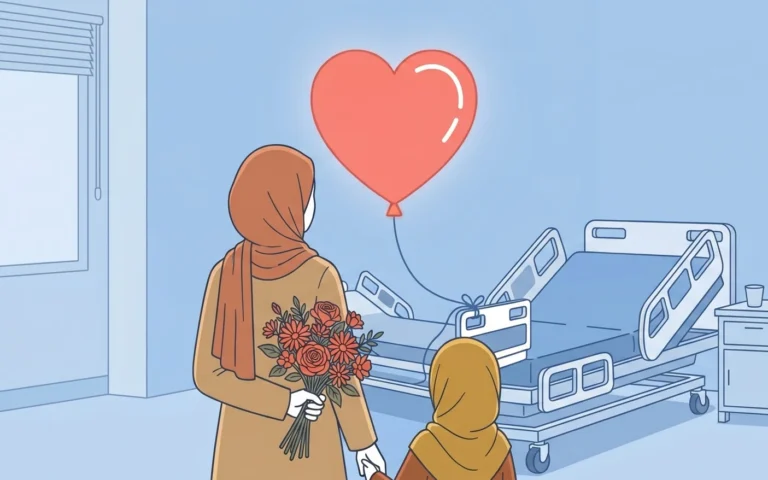
About ten years ago, the so-called ICE Bucket Challenge went viral to raise awareness for a disease: ALS (Amyotrophic Lateral Sclerosis). The goal was to advance research and care for this long-considered “incurable” condition. To this day, ALS is generally regarded as not curable, but merely manageable in its progression.
Yet a few months ago, the German Society for Neurology published a press release reporting on new pharmaceutical approaches. These open the possibility of not only controlling the disease, but in certain subtypes, even partially reversing existing nerve damage. Suddenly, the question arises whether ALS might indeed be curable in the future.
This is a striking example of a statement by the Prophet ︎:
مَا أَنْزَلَ اللَّهُ دَاءً إِلَّا أَنْزَلَ لَهُ شِفَاءً
Allah has not sent down a disease without also sending down a cure for it.
Sahih al-Bukhari 5678, Book 76, Hadith 1
From this hadith, a fundamental attitude toward illness emerges for the Muslim healthcare professional. In the true sense, there are no “incurable” diseases. Rather, there are diseases whose cures are not yet known to us.
This also means that from this perspective, it is not appropriate to tell a patient that their disease is fundamentally incurable or that nothing more can be done. Particularly with severe illnesses like advanced cancers, the question of “curative” or “palliative” frequently arises. Medically, this means that a cure is no longer pursued and symptom management takes priority.
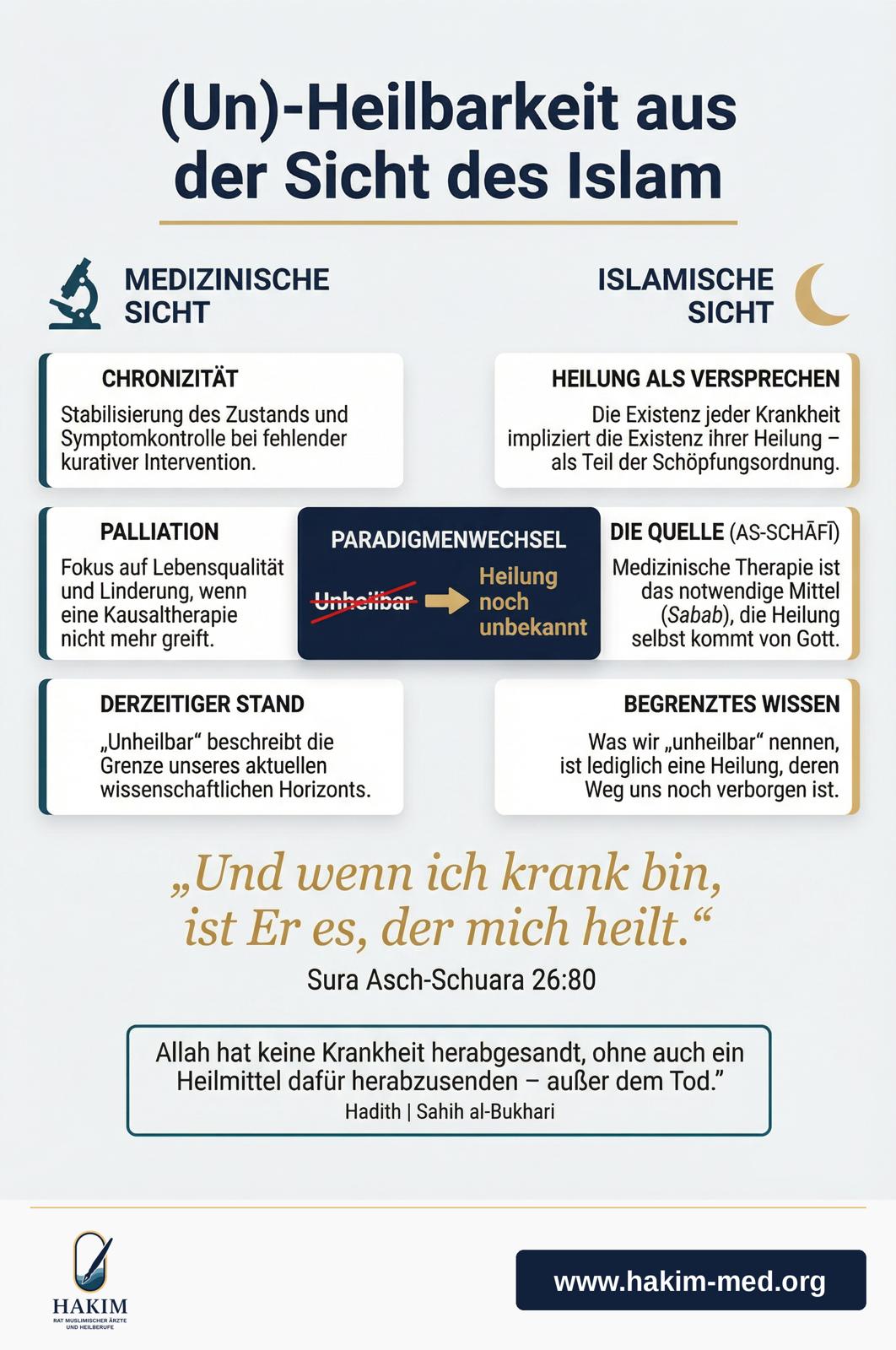
The Islamic stance, however, remains different. Every disease, no matter how complex, is in principle curable — even if we may not yet know the corresponding cure. At the same time, we are aware that it is not the remedy itself that effects healing, but Allah alone who heals.
As transmitted in the Quran through the words of Ibrahim (a.s.):
وَإِذَا مَرِضْتُ فَهُوَ يَشْفِينِ
And when I am ill, it is He who cures me.
Surah ash-Shuara 26:80
Moreover, remedies in Islam are not limited exclusively to medication. They also encompass supplication (Dua), Ruqya, and the Quran itself. Allah says:
وَنُنَزِّلُ مِنَ الْقُرْآنِ مَا هُوَ شِفَاءٌ وَرَحْمَةٌ لِّلْمُؤْمِنِينَ
And We send down of the Quran that which is a healing and a mercy for the believers.
Surah al-Isra 17:82
Ultimately, Allah alone decides which means He employs for healing. From this arises our responsibility to utilize all available resources — both material and spiritual.
For the Muslim healthcare professional, this means concretely: always conveying hope to the patient while providing a realistic medical assessment, yet avoiding the term “incurability” in an absolute sense, as it contradicts our understanding of faith.
At the same time, we are encouraged to actively seek cures and advance medical knowledge. In this context, Imam al-Ghazali classified the learning and advancement of medical knowledge as a Fard al-Kifaya — a communal obligation.
So when you next encounter a patient with advanced cancer, end-stage COPD, ALS, severe schizophrenia, or another serious illness, pause for a moment. Remind yourself that this illness, too, is ultimately amenable to healing — even if the path there may still be hidden from us.
Give the patient hope, but also an honest and realistic assessment of their situation. Yet avoid the final stamp of “incurability,” for it contradicts the inner attitude that our faith teaches us.